Spine surgery has evolved significantly over the last few decades. Traditional open spine surgery, once the standard approach for almost all spinal conditions, has gradually been complemented by newer minimally invasive techniques designed to reduce tissue damage and improve recovery.
One of the most advanced modern techniques is UBE (Unilateral Biportal Endoscopic) Spine Surgery, also known as Biportal Endoscopic Spine Surgery.
Patients researching treatment options for slipped disc, sciatica, lumbar canal stenosis, or nerve compression often ask:
Is UBE better than open spine surgery?
Which procedure has faster recovery?
Is minimally invasive surgery safer?
Does everyone qualify for UBE surgery?
The most important thing to understand is:
No single technique is best for every patient.
The ideal treatment depends on:
Type of spinal problem
Severity of nerve compression
Spinal instability
MRI findings
Number of spinal levels involved
Surgeon expertise
Overall patient health
Both UBE and traditional open spine surgery have important roles in modern spine care.
What is Open Spine Surgery?
Open spine surgery is the conventional surgical approach where a larger incision is made to directly access the spine.
This may involve:
Muscle dissection
Wider exposure of spinal structures
Direct visualization of nerves and bones
Open surgery has been successfully used for decades and remains extremely important for treating:
Complex spinal instability
Severe deformity
Multi-level spinal disease
Major trauma
Tumors and infections
Advanced spinal compression
In many complex cases, open surgery may still be the safest and most effective option.
What is UBE Spine Surgery?
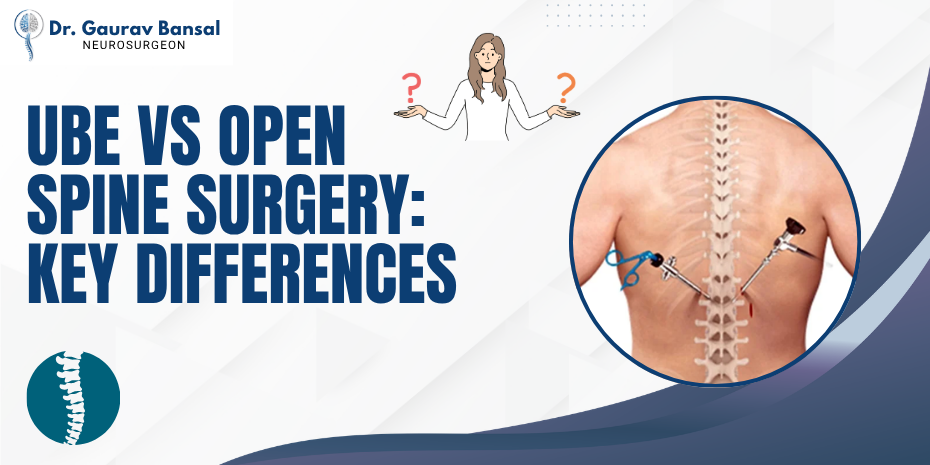
UBE (Unilateral Biportal Endoscopy) is a modern minimally invasive spine surgery technique that uses:
One small portal for the camera
One small portal for surgical instruments
The surgeon operates using a high-definition endoscopic camera with magnified visualization.
Unlike traditional open surgery, UBE aims to minimize muscle and tissue disruption while decompressing spinal nerves through tiny portals.
UBE is increasingly recognized as part of the evolution toward:
“4th Generation Endoscopic Spine Surgery”
because it combines:
Endoscopic technology
Advanced visualization
Surgical flexibility
Minimally invasive principles
Key Differences Between UBE & Open Spine Surgery
1. Incision Size
Open Spine Surgery
Larger surgical incision
Greater tissue exposure
UBE Spine Surgery
Two very small portals
Minimal skin incision
Smaller incisions may improve cosmetic outcomes and reduce tissue trauma.
2. Muscle Damage
Open Surgery
Traditional surgery often requires muscle stripping or dissection to expose the spine.
UBE Surgery
UBE preserves muscles as much as possible through minimally invasive access pathways.
Reduced muscle injury may help improve postoperative recovery in selected patients.
3. Visualization
Open Surgery
Direct visualization of spinal anatomy.
UBE Surgery
Uses a high-definition endoscopic camera with magnified illumination.
The endoscope provides excellent close-up visualization of nerves and spinal structures.
4. Blood Loss
Open Surgery
May involve greater blood loss in larger procedures.
UBE Surgery
Smaller surgical exposure may help reduce blood loss.
5. Recovery Time
Open Surgery
Recovery may take longer due to greater tissue disruption.
UBE Surgery
Many patients experience:
Earlier mobilization
Reduced postoperative discomfort
Faster return to routine activities
However, recovery varies depending on the condition and type of procedure.
6. Hospital Stay
Open Surgery
Complex procedures may require longer hospitalization.
UBE Surgery
Selected minimally invasive procedures may allow shorter hospital stay or early discharge.
7. Surgical Indications
Open Spine Surgery is Often Better Suited For:
Severe spinal instability
Complex deformity
Multi-level fusion
Major trauma
Extensive tumors or infections
UBE May Be Useful For:
Slipped disc
Sciatica
Lumbar canal stenosis
Foraminal stenosis
Selected revision surgery
Certain fusion procedures
The choice depends entirely on patient-specific factors.
Is UBE Always Better Than Open Surgery?
No.
UBE offers many minimally invasive advantages, but it is not the best option for every spinal condition.
Similarly, open surgery should not be viewed as “outdated.”
Modern spine surgery is about choosing:
The right procedure for the right patient.
Some patients benefit more from minimally invasive approaches, while others may require traditional open surgery for safety and long-term stability.
Advantages of UBE Spine Surgery
Potential advantages may include:
Smaller incisions
Less muscle damage
Reduced blood loss
Faster recovery
Early mobilization
Smaller scars
Shorter hospital stay in selected patients
These benefits are especially valuable in carefully selected cases.
Advantages of Open Spine Surgery
Traditional open surgery still provides important advantages in complex cases.
These include:
Wide surgical exposure
Direct access to spinal anatomy
Better correction of major deformities
Ability to perform extensive stabilization
Management of complex spinal pathology
For some patients, open surgery remains the safest and most effective treatment option.
Risks & Limitations
Both UBE and open spine surgery carry potential risks.
Possible Risks Include:
Infection
Bleeding
Nerve injury
Persistent pain
Dural tear (CSF leak)
Recurrent symptoms
Need for additional surgery
The risk profile depends more on the underlying spinal condition and surgical complexity than on incision size alone.
Recovery After Spine Surgery
Recovery depends on:
Severity of spinal disease
Surgical complexity
Patient age and health
Rehabilitation participation
General Recovery Expectations
UBE Surgery
Many patients walk early and recover faster due to minimal tissue disruption.
Open Surgery
Recovery may take longer, especially after complex fusion or deformity correction procedures.
Long-term success in both approaches also depends on:
Physiotherapy
Posture correction
Core strengthening
Weight management
Lifestyle modification
Frequently Asked Questions (FAQs)
Is UBE Spine Surgery Safer Than Open Surgery?
Both procedures can be safe when performed in appropriately selected patients by experienced spine surgeons.
Does UBE Have Faster Recovery?
Many patients experience faster recovery and less postoperative discomfort compared to open surgery
Can Open Surgery Still Be Necessary?
Yes. Many complex spinal conditions still require traditional open surgery.
Does UBE Cause Less Muscle Damage?
UBE aims to preserve muscles by using minimally invasive portals instead of larger open exposure.
Is UBE Suitable for Lumbar Canal Stenosis?
Yes. UBE is increasingly used for decompression in selected lumbar canal stenosis patients.
Is Open Surgery Outdated?
No. Open spine surgery remains essential for many complex spinal disorders.
Which Surgery is Best for Me?
The best treatment depends on your MRI findings, spinal condition, symptoms, instability, and overall health.