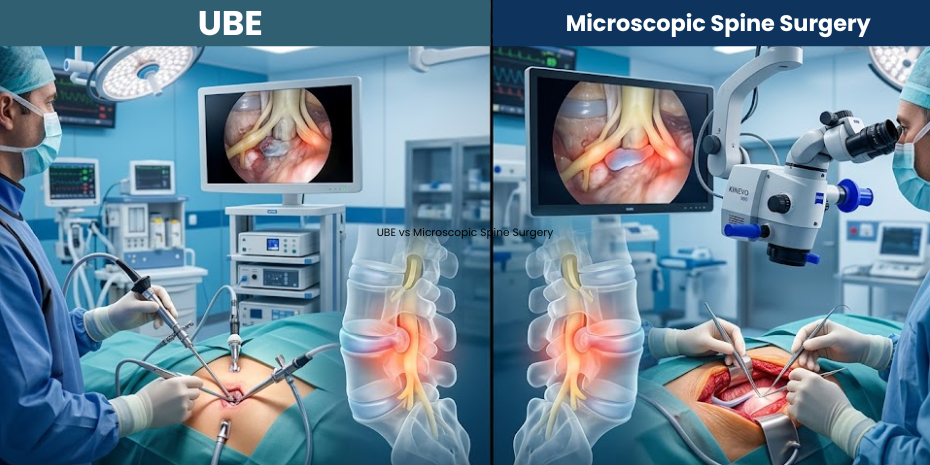
Understanding the Difference Between Two Advanced Minimally Invasive Spine Surgery Techniques
Modern spine surgery has evolved significantly over the last few decades.
Today, both Microscopic Spine Surgery and UBE (Unilateral Biportal Endoscopic) Spine Surgery are widely used minimally invasive techniques for treating conditions such as:
Slipped disc
Sciatica
Lumbar canal stenosis
Nerve compression
Degenerative spine disease
Patients often ask:
“Which surgery is better — UBE or Microscopic Spine Surgery?”
The most important point is:
No single technique is best for every patient.
The ideal surgical approach depends on:
Type of spinal problem
Severity of nerve compression
Spinal instability
Patient anatomy
Previous surgeries
Surgeon expertise and experience
Overall patient health and expectations
The goal should always be to select the safest, most effective, and most appropriate treatment for the individual patient.
What is Microscopic Spine Surgery?
Microscopic Spine Surgery uses a high-powered surgical microscope to provide magnified visualization during spinal procedures.
The microscope allows the surgeon to operate through smaller incisions with improved precision compared to traditional open surgery.
Microscopic surgery has been an important milestone in the evolution of minimally invasive spine surgery and remains widely used worldwide.
Common Uses
Microscopic discectomy
Lumbar decompression
Cervical disc surgery
Nerve decompression procedures
What is UBE Spine Surgery?
UBE (Unilateral Biportal Endoscopic) Spine Surgery is an advanced minimally invasive endoscopic technique that uses:
One portal for the camera
One portal for surgical instruments
This biportal system allows continuous visualization and greater instrument flexibility during surgery.
UBE is increasingly recognized as part of the evolution toward 4th Generation Endoscopic Spine Surgery.
Common Uses
UBE discectomy
UBE decompression
UBE for lumbar canal stenosis
UBE-TLIF fusion surgery
Selected revision spine surgery cases
Similarities Between UBE & Microscopic Spine Surgery
Both techniques are modern minimally invasive approaches designed to reduce tissue damage compared to traditional open surgery.
Shared Goals
Smaller Incisions
Both approaches use smaller surgical openings.
Less Muscle Injury
Muscles are preserved as much as possible.
Reduced Postoperative Pain
Minimal tissue disruption may improve recovery comfort.
Faster Recovery
Many patients recover faster than with open surgery.
Early Mobilization
Walking often begins early after surgery.
Better Visualization
Both techniques provide magnified surgical views.
Nerve Decompression
Both aim to safely relieve pressure on spinal nerves.
Key Differences Between UBE & Microscopic Spine Surgery
Visualization Method
Microscopic Surgery
Uses an operating microscope positioned outside the body.
UBE Surgery
Uses a high-definition endoscopic camera inserted through a portal.
Surgical Access
Microscopic Surgery
Typically performed through a small incision using retractors.
UBE Surgery
Uses two separate portals:
One for visualization
One for instruments
This allows greater instrument mobility.
Working Space
Microscopic Surgery
Operates through a focused surgical corridor.
UBE Surgery
Provides continuous saline irrigation and wider endoscopic visualization.
Instrument Flexibility
UBE Surgery
The biportal system may allow greater freedom of instrument movement during decompression.
This can be particularly useful in selected stenosis and decompression procedures.
Learning Curve
UBE Surgery
UBE is technically advanced and may involve a significant learning curve.
Surgeon training and experience are extremely important.
Microscopic Surgery
Microscopic techniques have been established for many years and remain highly effective.
When Might Microscopic Surgery Be Preferred?
Microscopic spine surgery may be preferred in selected situations such as:
Certain slipped disc cases
Focused decompression procedures
Selected cervical spine surgeries
Specific anatomical situations
Cases where microscope-assisted surgery offers optimal precision
The choice depends on the pathology and surgeon judgment.
When Might UBE Be Useful?
UBE may offer advantages in selected patients requiring:
Wider decompression
Lumbar canal stenosis surgery
Multi-directional visualization
Minimally invasive decompression
Selected revision surgeries
Advanced endoscopic approaches
UBE can also be useful for selected fusion procedures such as UBE-TLIF.
Is UBE Better Than Microscopic Surgery?
The answer is not simply “yes” or “no.”
The Correct Surgical Technique Depends On
Patient symptoms
MRI findings
Spinal stability
Severity of compression
Surgical goals
Surgeon expertise
Available technology
Individual patient factors
A technique is only effective when:
Properly indicated
Carefully planned
Performed by an experienced surgeon
The best surgery is the one that safely and effectively addresses the patient’s specific spinal problem.
Advantages of UBE Spine Surgery
Potential Advantages
Tiny portals
Wide endoscopic visualization
Continuous irrigation
Reduced tissue trauma
Greater instrument flexibility
Advanced decompression capability
Early mobilization
Advantages of Microscopic Spine Surgery
Potential Advantages
Established long-term track record
Excellent magnified visualization
Precise decompression
Familiar anatomy for many surgeons
Effective for many standard spinal procedures
Limitations of Both Techniques
No surgical technique is perfect or suitable for every condition.
Important Limitations
UBE Limitations
Technical learning curve
May not suit all complex deformities
Requires specialized training and equipment
Microscopic Surgery Limitations
May involve slightly greater tissue disruption compared to some endoscopic approaches
Certain complex decompressions may be technically demanding through narrow corridors
The correct approach should always be individualized.
Patient Safety is More Important Than Technology Alone
Modern spine surgery should never focus only on “newer” technology.
The most important factors are:
Accurate diagnosis
Appropriate patient selection
Ethical surgical decision-making
Surgeon expertise
Evidence-based treatment planning
Not every patient requires surgery, and not every surgery requires the latest technology.
The goal should always be:
“Right surgery, for the right patient, at the right time.”
Frequently Asked Questions
Is UBE More Advanced Than Microscopic Surgery?
UBE is a newer endoscopic development and offers certain technological advantages, but both techniques remain valuable and effective when appropriately used.
Which Surgery Has Faster Recovery?
Both are minimally invasive techniques and generally offer faster recovery compared to traditional open surgery.
Recovery depends more on the patient’s condition and the procedure performed.
Is UBE Less Painful?
UBE may reduce tissue trauma in selected procedures, but postoperative experience varies from patient to patient.
Is Microscopic Surgery Still Commonly Used?
Yes. Microscopic spine surgery remains one of the most widely used and effective minimally invasive spine surgery techniques worldwide.
Which Technique is Better for Slipped Disc?
Both microscopic discectomy and UBE discectomy can be effective. The choice depends on the specific spinal condition and surgical planning.
Which Technique is Better for Lumbar Canal Stenosis?
UBE may provide advantages in selected stenosis decompression procedures because of wider endoscopic visualization and instrument flexibility.
Can Both Techniques Be Minimally Invasive?
Yes. Both UBE and microscopic spine surgery are minimally invasive approaches.
Choosing the Right Spine Surgery Approach
Every spine problem is different.
The best treatment plan should always be based on:
Detailed clinical evaluation
MRI findings
Functional symptoms
Patient goals
Scientific evidence
Surgeon experience
An individualized, patient-centered approach is essential for achieving the best outcomes.
Book a Consultation
If you are suffering from slipped disc, sciatica, lumbar canal stenosis, or persistent spinal symptoms, expert evaluation can help determine the most appropriate treatment option for your condition.
Schedule Your Appointment Today
MRI Review
Spine Evaluation
UBE Spine Surgery Consultation
Microscopic Spine Surgery Consultation
Second Opinion for Spine Surgery