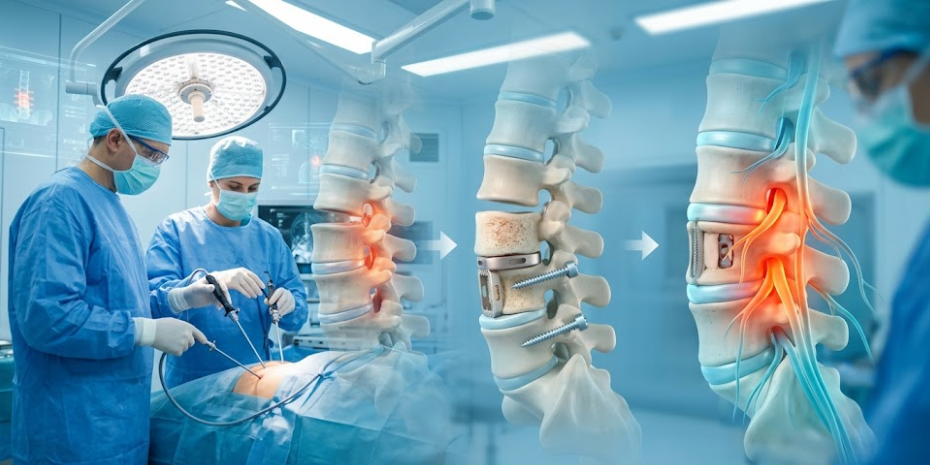
Advanced Minimally Invasive Spine Stabilization Surgery
Endoscopic Spine Fusion is an advanced minimally invasive surgical procedure used to stabilize the spine in selected patients with instability, severe degeneration, recurrent disc problems, or deformity-related pain.
Modern techniques such as UBE-TLIF (Unilateral Biportal Endoscopic Transforaminal Lumbar Interbody Fusion) combine endoscopic visualization with spinal fusion technology to reduce tissue damage while achieving spinal stability.
Compared to traditional open fusion surgery, endoscopic fusion aims to minimize muscle injury, reduce postoperative pain, and support faster recovery in appropriately selected patients.
What is Endoscopic Spine Fusion?
Spinal fusion is a procedure designed to stabilize two or more vertebrae by encouraging them to heal together into a single stable segment.
In endoscopic spine fusion, the procedure is performed using:
Small incisions
Endoscopic camera visualization
Specialized minimally invasive instruments
The surgery may involve:
Removal of damaged disc material
Nerve decompression
Placement of a cage or spacer between vertebrae
Stabilization using screws and rods in selected cases
UBE-TLIF is one of the most advanced forms of endoscopic fusion surgery.
Who May Need Endoscopic Spine Fusion?
Endoscopic fusion may be considered in patients with spinal instability or severe degenerative spine conditions.
Common Conditions Where Fusion May Be Recommended
Spondylolisthesis
One vertebra slips over another causing instability and nerve compression.
Degenerative Disc Disease
Advanced disc degeneration associated with chronic pain and instability.
Recurrent Slipped Disc
Repeated disc prolapse causing ongoing symptoms.
Lumbar Canal Stenosis With Instability
Spinal narrowing combined with abnormal spinal movement.
Mechanical Back Pain
Pain arising from unstable spinal segments.
Selected Revision Spine Surgery Cases
Persistent symptoms after previous spine procedures.
Not every patient with back pain or slipped disc requires fusion surgery.
The decision depends on detailed clinical evaluation, imaging findings, and symptom severity.
How is Endoscopic Spine Fusion Performed?
Step-by-Step Overview
Small Incisions
Tiny portals are created to access the affected spinal level.
Endoscopic Visualization
A high-definition camera provides magnified visualization of nerves, discs, and spinal structures.
Nerve Decompression
Compressed nerves are carefully decompressed.
Disc Removal
Damaged disc material is removed from between the vertebrae.
Cage Placement
A fusion cage filled with bone graft material may be inserted to support fusion.
Stabilization
Screws and rods may be placed through minimally invasive techniques to stabilize the spine.
Fusion Process
Over time, the vertebrae heal together to create a stable spinal segment.
Benefits of Endoscopic Spine Fusion
Key Advantages
Minimally Invasive Approach
Smaller incisions reduce tissue trauma.
Less Muscle Damage
Muscles are preserved as much as possible.
Reduced Blood Loss
Less soft tissue disruption often leads to lower blood loss.
Smaller Scars
Cosmetic outcomes are generally improved.
Reduced Postoperative Pain
Many patients experience less postoperative discomfort.
Faster Recovery
Patients often mobilize earlier compared to traditional open fusion surgery.
Shorter Hospital Stay
Hospitalization may be reduced in selected patients.
Better Visualization
Endoscopic magnification allows precise decompression and fusion work.
Why UBE-TLIF is Considered a Major Advancement
UBE-TLIF combines the principles of:
Endoscopic surgery
Minimally invasive fusion
Advanced decompression techniques
The biportal approach provides:
Wider visualization
Greater instrument freedom
Better decompression capability
Familiar surgical anatomy
This allows surgeons to perform complex decompression and fusion procedures through minimally invasive access.
UBE-TLIF is increasingly recognized as part of the evolution toward 4th Generation Endoscopic Spine Surgery.
Risks & Limitations of Endoscopic Spine Fusion
Although advanced and minimally invasive, spinal fusion remains a major surgical procedure.
Possible Risks Include
Infection
Bleeding
Nerve injury
Dural tear (CSF leak)
Persistent pain
Implant-related complications
Failure of fusion (non-union)
Adjacent segment degeneration
Recurrent symptoms
Limitations
Endoscopic fusion may not be suitable for:
Severe spinal deformity
Extensive multi-level instability
Certain osteoporosis cases
Complex tumors or infections
Some highly advanced degenerative conditions
Careful patient selection is essential.
Recovery Timeline After Endoscopic Spine Fusion
Recovery varies depending on:
Number of spinal levels treated
Severity of instability
Overall patient health
Rehabilitation participation
General Recovery Timeline
Same Day / Next Day
Walking usually begins early under supervision
1–2 Weeks
Reduction in surgical discomfort
Gradual increase in activity
2–6 Weeks
Improved mobility
Light routine activities resumed
6–12 Weeks
Progressive strengthening and rehabilitation
3–6 Months
Ongoing fusion healing and functional recovery
Full spinal fusion develops gradually over time.
Physiotherapy and lifestyle modifications remain important during recovery.
Who May Not Be Suitable for Endoscopic Fusion?
Alternative approaches may sometimes be recommended for:
Severe deformity
Extensive instability
Advanced osteoporosis
Certain complex revision surgeries
Major spinal infections or tumors
The final decision depends on clinical evaluation and imaging findings.
Frequently Asked Questions
Is Endoscopic Fusion Less Painful Than Open Surgery?
Many patients experience reduced postoperative pain because of smaller incisions and less muscle damage.
How Long is Hospital Stay?
Hospital stay is often shorter compared to conventional open fusion surgery, depending on the procedure and patient recovery.
Will Implants Be Used?
Fusion surgery commonly involves placement of cages, screws, and rods for stabilization.
Is Fusion Permanent?
The goal of fusion is to create long-term spinal stability by allowing the vertebrae to heal together.
When Can I Return to Work?
Return to work depends on recovery progress, fusion healing, and job demands.
Is Endoscopic Fusion Suitable for Every Patient?
No. Treatment decisions are individualized based on symptoms, instability, MRI findings, and overall spinal condition.
Book a Consultation for Endoscopic Spine Fusion
If you are experiencing persistent back pain, spinal instability, recurrent slipped disc symptoms, or walking difficulty, expert spine evaluation can help determine whether endoscopic spine fusion may be appropriate for your condition.
Schedule Your Appointment Today
MRI Review
Spine Stability Evaluation
UBE-TLIF Consultation
Revision Spine Surgery Consultation
Personalized Treatment Planning