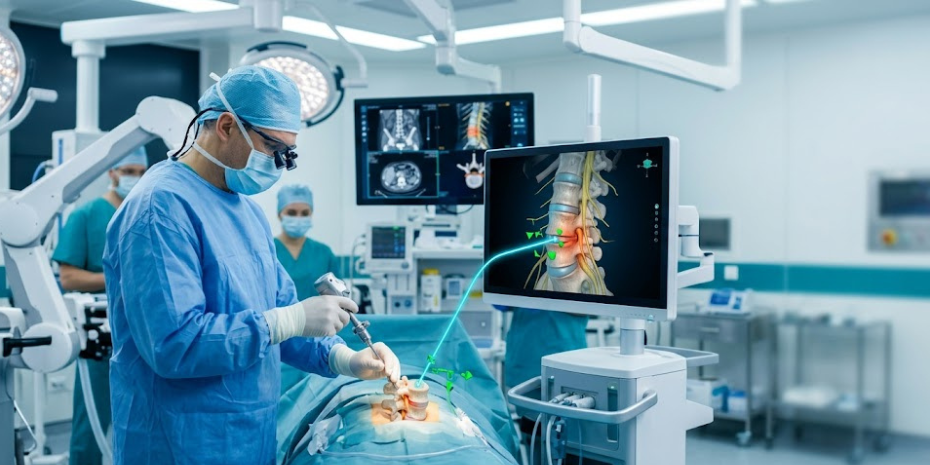
Advanced Precision Spine Surgery Using Modern Navigation Technology
Navigation-Guided Spine Surgery is an advanced surgical technique that uses real-time computer-assisted imaging and navigation systems to improve precision during spine procedures.
Often compared to a “GPS system for spine surgery,” navigation technology helps surgeons visualize spinal anatomy with greater accuracy during complex procedures.
Modern navigation systems are increasingly used in:
Minimally invasive spine surgery
Spinal fusion procedures
Revision spine surgery
Deformity correction
Pedicle screw placement
Complex spinal stabilization procedures
The goal is to improve surgical precision while enhancing patient safety and optimizing outcomes.
What is Navigation-Guided Spine Surgery?
Navigation-guided spine surgery combines:
Advanced imaging technology
Real-time computer guidance
Specialized tracking systems
Intraoperative visualization tools
to assist the surgeon during spinal procedures.
The system creates a detailed 3D map of the spine, helping guide surgical instruments and implant placement with high accuracy.
It is commonly used alongside:
Minimally invasive spine surgery
Endoscopic spine surgery
Robotic-assisted spine surgery
Fusion procedures such as TLIF
Who May Need Navigation-Guided Spine Surgery?
Navigation technology may be beneficial for patients undergoing complex or precision-demanding spine procedures.
Common Situations Where Navigation May Be Used
Spinal Fusion Surgery
Accurate placement of screws and implants.
Revision Spine Surgery
Previously operated anatomy may be altered or scarred.
Spinal Deformity Surgery
Complex spinal alignment correction procedures.
Minimally Invasive Spine Surgery
Smaller incisions require greater imaging precision.
Multi-Level Spine Surgery
Procedures involving multiple spinal segments.
Cervical, Thoracic & Lumbar Procedures
Navigation can assist surgeries throughout different spinal regions.
Conditions Commonly Treated Using Navigation Assistance
Degenerative spine disease
Spinal instability
Spondylolisthesis
Lumbar canal stenosis
Recurrent slipped disc
Spinal deformity
Selected trauma cases
Complex revision surgeries
The use of navigation depends on the procedure complexity and surgeon preference.
How is Navigation-Guided Spine Surgery Performed?
Step-by-Step Overview
Intraoperative Imaging
Advanced imaging such as 3D scans or fluoroscopy is obtained during surgery.
Creation of a Digital Spine Map
The navigation system generates a detailed real-time image of the patient’s spine.
Instrument Tracking
Specialized instruments are tracked on the navigation screen during surgery.
Guided Implant Placement
The surgeon uses navigation assistance to place screws, implants, or instruments with improved precision.
Real-Time Verification
The system helps confirm proper alignment and positioning during the procedure.
Navigation technology supports the surgeon’s decision-making but does not replace surgical expertise.
Role of Navigation in Minimally Invasive Spine Surgery
Modern minimally invasive procedures often use small incisions that limit direct visualization.
Navigation technology helps improve precision during:
Minimally invasive decompression
Fusion surgery
UBE-TLIF procedures
Revision surgery
Complex instrumentation placement
It is particularly useful in advanced spine centers performing high-precision procedures.
Benefits of Navigation-Guided Spine Surgery
Key Advantages
Improved Surgical Precision
Enhanced visualization helps guide instrument placement accurately.
Better Implant Accuracy
Navigation may improve precision during pedicle screw placement.
Enhanced Safety
Real-time imaging helps reduce risk of incorrect positioning.
Useful in Complex Cases
Particularly valuable in revision surgery and deformity correction.
Supports Minimally Invasive Techniques
Smaller surgical exposures benefit from navigation assistance.
Reduced Radiation Exposure in Selected Situations
Modern systems may reduce repeated fluoroscopy exposure in some procedures.
Better Surgical Planning
Real-time visualization improves intraoperative decision-making.
Improved Confidence in Difficult Anatomy
Especially beneficial in altered or complex spinal anatomy.
Navigation-Guided Surgery & Endoscopic Spine Surgery
Navigation systems are increasingly integrated with:
Endoscopic spine surgery
UBE (Unilateral Biportal Endoscopic) surgery
Minimally invasive spinal fusion
Advanced decompression procedures
This combination allows surgeons to perform highly precise procedures while minimizing tissue trauma.
Risks & Limitations of Navigation-Guided Spine Surgery
Although navigation technology offers major advantages, it also has limitations.
Possible Limitations Include
Technology Dependence
The system assists the surgeon but does not replace surgical expertise.
Increased Operative Setup Time
Navigation systems require additional preparation and imaging.
Availability Limitations
Advanced navigation technology may not be available in all hospitals.
Cost Considerations
Navigation-assisted procedures may increase procedural costs in some settings.
Imaging Dependency
Accurate navigation depends on proper imaging acquisition and registration.
Potential Risks
The risks are generally related to the underlying spine surgery itself and may include:
Infection
Bleeding
Nerve injury
Implant-related complications
Persistent symptoms
Dural tear (CSF leak)
Navigation technology is designed to improve precision but cannot completely eliminate surgical risks.
Recovery Timeline After Navigation-Guided Spine Surgery
Recovery depends primarily on:
The spinal condition being treated
Type of procedure performed
Extent of surgery
Patient health and rehabilitation
General Recovery Expectations
Same Day / Next Day
Early walking and mobilization may begin
1–2 Weeks
Improvement in surgical discomfort
Gradual increase in activity
2–6 Weeks
Improved mobility and function
Return to light routine activities in selected patients
6–12 Weeks
Continued rehabilitation and strengthening
Patients undergoing minimally invasive navigation-assisted procedures may experience faster recovery compared to traditional open surgery.
Who May Not Need Navigation-Guided Surgery?
Not every spine surgery requires navigation technology.
Simple or straightforward procedures may often be safely performed without advanced navigation systems.
The decision depends on:
Surgical complexity
Anatomy
Type of procedure
Surgeon expertise
Available technology
An individualized approach is important.
Frequently Asked Questions
Is Navigation-Guided Spine Surgery Robotic Surgery?
Not necessarily. Navigation systems assist with imaging and guidance, while robotic systems may additionally assist instrument positioning.
Does Navigation Improve Surgical Accuracy?
Navigation technology is designed to improve precision and visualization during spine procedures.
Is Navigation Used in Minimally Invasive Surgery?
Yes. Navigation is commonly used in minimally invasive and endoscopic spine surgery.
Does Every Spine Surgery Need Navigation?
No. Navigation is most useful in selected complex or precision-demanding procedures.
Is Navigation-Guided Surgery Safer?
Navigation systems are intended to enhance accuracy and support surgical safety, especially in complex procedures.
Will Recovery Be Faster?
Recovery depends more on the underlying surgery and patient condition, although minimally invasive navigation-assisted procedures may support faster rehabilitation.
Ethical & Evidence-Based Use of Spine Technology
Advanced technology should always support patient care — not replace clinical judgment.
Our approach focuses on:
Appropriate use of modern technology
Personalized surgical planning
Evidence-based treatment decisions
Minimally invasive techniques whenever suitable
Patient safety and long-term outcomes
The goal is to combine surgical expertise with modern precision technology for optimal spine care.
Book a Consultation for Advanced Spine Surgery
If you are suffering from persistent back pain, sciatica, spinal instability, or complex spinal conditions, expert evaluation can help determine whether navigation-guided spine surgery may be appropriate for your treatment.
Schedule Your Appointment Today
MRI Review
Advanced Spine Surgery Consultation
Minimally Invasive Spine Surgery Evaluation
Endoscopic Spine Surgery Consultation
Second Opinion for Spine Surgery