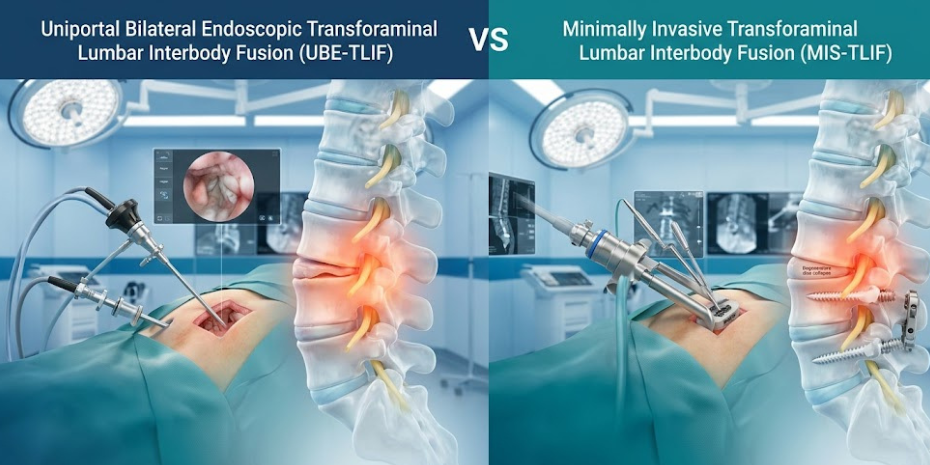
Understanding Modern Minimally Invasive Spine Fusion Techniques
Spinal fusion surgery has evolved significantly over the years, with modern minimally invasive techniques aiming to reduce tissue damage, improve recovery, and preserve spinal stability while effectively treating nerve compression and instability.
Two advanced minimally invasive fusion techniques commonly discussed today are:
· UBE-TLIF (Unilateral Biportal Endoscopic Transforaminal Lumbar Interbody Fusion)
· MIS-TLIF (Minimally Invasive Transforaminal Lumbar Interbody Fusion)
Both procedures are designed to achieve spinal decompression and stabilization while minimizing the muscle injury associated with traditional open fusion surgery.
Importantly:
No single technique is best for every patient.
The correct surgical approach depends on:
· Type of spinal pathology
· Degree of instability
· Patient anatomy
· Severity of nerve compression
· Bone quality
· Previous surgeries
· Surgeon experience and expertise
· Individual recovery goals
The goal should always be safe, evidence-based, and personalized spine care.
What is MIS-TLIF?
MIS-TLIF stands for:
Minimally Invasive Transforaminal Lumbar Interbody Fusion
It is a minimally invasive fusion procedure performed through smaller incisions using tubular retractors, microscopes, or specialized minimally invasive instruments.
The surgery typically involves:
· Nerve decompression
· Removal of damaged disc material
· Placement of an interbody fusion cage
· Stabilization using screws and rods
MIS-TLIF represented a major advancement over traditional open fusion surgery by reducing muscle dissection and postoperative recovery time.
What is UBE-TLIF?
UBE-TLIF stands for:
Unilateral Biportal Endoscopic Transforaminal Lumbar Interbody Fusion
This technique combines:
· Endoscopic visualization
· Biportal surgical access
· Minimally invasive fusion principles
UBE-TLIF uses:
· One portal for the endoscopic camera
· One portal for surgical instruments
The high-definition endoscopic system provides magnified visualization while allowing independent instrument movement and decompression.
UBE-TLIF is increasingly recognized as part of the evolution toward:
“4th Generation Endoscopic Spine Surgery”
because it combines modern endoscopic technology with minimally invasive fusion surgery.
Common Goal of Both Procedures
Both UBE-TLIF and MIS-TLIF aim to:
· Relieve nerve compression
· Stabilize the spine
· Reduce pain
· Improve walking and function
· Restore spinal alignment when necessary
Both are minimally invasive alternatives to traditional open fusion surgery.
Conditions Commonly Treated
Both Techniques May Be Used For
· Spondylolisthesis
· Lumbar canal stenosis with instability
· Degenerative disc disease
· Recurrent slipped disc
· Foraminal stenosis
· Mechanical back pain
· Selected revision spine surgery cases
The final surgical choice depends on patient-specific evaluation.
Key Technical Difference
MIS-TLIF
· Typically performed using tubular retractors or microscope-assisted minimally invasive techniques
· Access through a small muscle-splitting pathway
· Direct microscopic or fluoroscopic visualization
UBE-TLIF
· Uses two independent portals
· One portal for the camera
· One portal for instruments
· Continuous endoscopic visualization
· Greater flexibility of instrument movement
Both techniques are designed to reduce muscle injury compared to open surgery.
Visualization & Surgical Working Space
UBE-TLIF
The biportal system may provide:
· Wider endoscopic visualization
· Better illumination
· Independent instrument maneuverability
· Continuous irrigation for a clearer surgical field
This may help in selected decompression and fusion procedures.
MIS-TLIF
MIS-TLIF offers:
· Established minimally invasive fusion principles
· Smaller muscle-splitting access pathways
· Reduced tissue disruption compared to open surgery
· Familiar workflow for many spine surgeons
MIS-TLIF remains a widely accepted and effective minimally invasive fusion technique worldwide.
Muscle Preservation & Tissue Damage
Both procedures aim to minimize tissue trauma compared to traditional open fusion surgery.
Shared Minimally Invasive Advantages
· Smaller incisions
· Reduced muscle injury
· Less blood loss
· Faster mobilization
· Reduced postoperative discomfort
· Shorter hospital stay in selected patients
· Faster rehabilitation potential
Recovery varies based on:
· Surgical complexity
· Number of spinal levels treated
· Bone quality
· Patient health condition
UBE-TLIF & the “4th Generation” Concept
UBE-TLIF is often associated with:
“4th Generation Endoscopic Spine Surgery”
because it combines:
· Endoscopic visualization
· Advanced decompression capability
· Biportal instrument freedom
· Minimally invasive fusion principles
The goal is to expand the range of spinal conditions that can be treated through advanced endoscopic techniques.
However, this does not mean older techniques are outdated.
Modern spine surgery includes multiple highly effective approaches, each with its own strengths and indications.
Is UBE-TLIF Better Than MIS-TLIF?
The Most Important Principle:
No single technique is ideal for every patient.
The “best” procedure depends on:
· Degree of instability
· Anatomy of nerve compression
· Severity of degeneration
· Bone quality
· Revision surgery history
· Number of spinal levels involved
· Surgeon expertise and familiarity
In experienced hands, both UBE-TLIF and MIS-TLIF can provide excellent outcomes in properly selected patients.
The focus should always be on selecting the most appropriate procedure — not simply the newest technology.
How Surgeons Decide the Right Fusion Technique
The decision is individualized after careful evaluation.
Important Factors Include
Pathology
· Type of instability
· Degree of stenosis
· Disc degeneration
· Nerve compression pattern
Patient Factors
· Age
· Bone density
· Medical fitness
· Activity level
· Recovery expectations
Technical Considerations
· Surgical access requirements
· Visualization needs
· Fusion goals
· Revision surgery complexity
Surgeon training and expertise also play a major role in determining the safest and most effective approach.
Benefits of Modern Minimally Invasive Fusion Surgery
Both UBE-TLIF and MIS-TLIF may offer important advantages compared to traditional open fusion surgery.
Potential Benefits Include
· Smaller incisions
· Reduced muscle trauma
· Less blood loss
· Faster recovery
· Reduced postoperative pain
· Early mobilization
· Smaller scars
· Faster return to daily activities
Risks & Limitations
Like all spinal fusion procedures, both techniques carry potential risks.
Possible Risks Include
· Infection
· Bleeding
· Nerve irritation or injury
· Implant-related complications
· Dural tear (CSF leak)
· Persistent pain
· Delayed or incomplete fusion
· Adjacent segment degeneration
· Recurrent symptoms
Not all patients are suitable candidates for minimally invasive fusion procedures.
Certain complex conditions may still require alternative surgical approaches.
Frequently Asked Questions
Is UBE-TLIF More Advanced Than MIS-TLIF?
UBE-TLIF represents a newer evolution in endoscopic fusion surgery, but both procedures are advanced minimally invasive techniques.
Which Procedure Has Faster Recovery?
Both procedures are designed to reduce tissue trauma and may allow faster recovery compared to traditional open fusion surgery.
Is UBE-TLIF Completely Endoscopic?
UBE-TLIF uses endoscopic visualization with separate portals for the camera and instruments.
Does MIS-TLIF Still Have an Important Role?
Yes. MIS-TLIF remains a widely used and highly effective minimally invasive fusion technique.
Which Procedure is Better for Lumbar Canal Stenosis?
The ideal procedure depends on the extent of stenosis, instability, anatomy, and surgeon expertise.
Does Every Patient with Back Pain Need Fusion Surgery?
No. Most back pain patients improve with conservative treatment and never require fusion surgery.
How is the Final Surgical Decision Made?
The final decision is based on clinical evaluation, MRI findings, spinal stability, patient goals, and surgeon expertise.
Ethical & Evidence-Based Spine Care
Modern spine surgery should focus on:
· Accurate diagnosis
· Appropriate patient selection
· Conservative care whenever possible
· Personalized treatment planning
· Evidence-based surgical recommendations
Different patients require different surgical strategies.
The goal is not to promote one technique for every patient, but to choose the safest and most suitable procedure for each individual condition.
Book a Consultation for Minimally Invasive Fusion Surgery
If you are suffering from spinal instability, lumbar canal stenosis, recurrent slipped disc, or persistent nerve compression symptoms, expert evaluation can help determine whether minimally invasive fusion surgery may be appropriate for your condition.
Schedule Your Appointment Today
· MRI Review
· Spine Stability Assessment
· UBE-TLIF Consultation
· MIS-TLIF Consultation
· Second Opinion for Spine Surgery