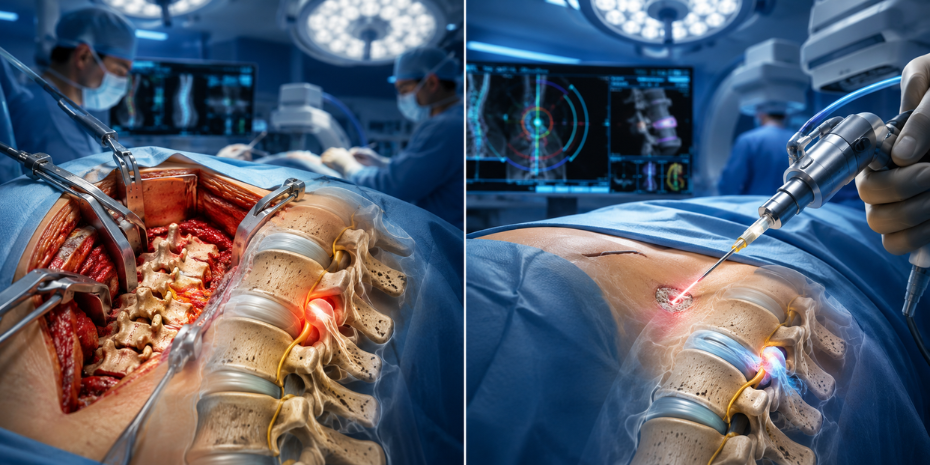
Understanding Different Approaches in Modern Spine Treatment
Patients searching for spine treatment options often come across terms such as:
· Traditional Spine Surgery
· Laser Spine Surgery
· Minimally Invasive Spine Surgery
· Endoscopic Spine Surgery
This can sometimes create confusion and unrealistic expectations.
The most important thing to understand is:
No single technique is best for every patient.
The correct treatment approach depends on:
· Type of spinal problem
· Severity of nerve compression
· Presence of spinal instability
· Patient anatomy
· MRI findings
· Surgeon experience
· Overall health and recovery goals
The goal should never be simply choosing a “popular” or “marketed” technology — but selecting the safest and most effective treatment for the individual patient.
What is Traditional Spine Surgery?
Traditional spine surgery refers to conventional spinal procedures performed through larger surgical exposure to access the spine directly.
These procedures have been successfully used for decades and continue to remain important for many complex spinal conditions.
Traditional Spine Surgery May Include
· Open decompression surgery
· Open discectomy
· Laminectomy
· Spinal fusion surgery
· Deformity correction
· Trauma stabilization
Traditional surgery may still be the most appropriate option for certain patients, especially when extensive decompression or stabilization is required.
What is Laser Spine Surgery?
The term “Laser Spine Surgery” is commonly used in marketing and patient education, but it is important to understand what it actually means.
In many cases, laser technology is simply one tool that may be used during a minimally invasive spinal procedure.
A laser itself does not replace the surgery.
The actual procedure may still involve:
· Endoscopic surgery
· Microscopic surgery
· Disc decompression
· Nerve decompression
· Minimally invasive surgical access
In modern spine surgery, lasers may occasionally assist with tissue vaporization or disc-related procedures in selected situations.
However, most spinal decompression is still performed using specialized surgical instruments rather than laser energy alone.
Understanding the Real Difference
The true difference is usually not:
“Laser vs Non-Laser”
but rather:
Open Surgery vs Minimally Invasive Surgery
Modern minimally invasive spine surgery may use:
· Microscopes
· Endoscopes
· Tubular retractors
· High-speed drills
· Radiofrequency systems
· Specialized surgical instruments
· Occasionally laser technology in selected cases
The most important factor is not whether a laser is used, but whether the chosen technique safely and effectively treats the underlying spinal problem.
When is Traditional Spine Surgery Still Important?
Traditional open surgery continues to play a very important role in modern spine care.
It May Be Recommended For
Severe Spinal Instability
Conditions requiring extensive stabilization.
Complex Spinal Deformity
Scoliosis or major spinal imbalance.
Multi-level Compression
Extensive disease involving several spinal levels.
Major Trauma
Complex fractures or spinal cord injuries.
Tumors or Infections
Conditions requiring wider surgical exposure.
Complex Revision Surgery
Selected repeat spinal procedures after previous surgery.
In these situations, open surgery may provide better access, stability, and safety.
When Are Minimally Invasive or Endoscopic Techniques Useful?
Modern minimally invasive approaches may be appropriate for selected conditions such as:
· Slipped disc
· Sciatica
· Lumbar canal stenosis
· Foraminal stenosis
· Selected cervical disc problems
· Certain fusion procedures
These procedures may include:
· Endoscopic spine surgery
· UBE (Biportal Endoscopic) surgery
· Microscopic spine surgery
· Tubular minimally invasive surgery
In selected patients, minimally invasive techniques may reduce tissue trauma and recovery time.
Is Laser Spine Surgery Better?
The term “laser spine surgery” can sometimes create the impression that lasers automatically make surgery safer, easier, or scar-free.
In reality:
The success of spine surgery depends far more on:
· Correct diagnosis
· Proper patient selection
· Appropriate surgical planning
· Surgical expertise
· Safe decompression and stabilization
rather than simply whether a laser is used.
For many spinal conditions, excellent results are achieved without laser technology.
Traditional Surgery vs Minimally Invasive Surgery
Traditional Spine Surgery
Advantages
· Direct visualization of anatomy
· Useful for complex cases
· Suitable for major stabilization procedures
· Effective for severe deformity and trauma
Limitations
· Larger incisions
· Greater muscle dissection
· Longer recovery in some cases
Minimally Invasive / Endoscopic Surgery
Advantages
· Smaller incisions
· Reduced tissue damage
· Faster mobilization
· Less postoperative discomfort
· Smaller scars
Limitations
· Not suitable for every condition
· Technically demanding
· Requires specialized expertise
· May not address certain complex deformities or instability
Why the Right Technique Matters More Than the Trend
Modern spine surgery should always be individualized.
The ideal treatment depends on:
Pathology
What spinal condition is present?
Anatomy
How accessible is the pathology?
Instability
Is spinal stabilization required?
Neurological Compression
How severe is nerve compression?
Surgeon Expertise
Which technique can be performed most safely and effectively?
Patient Goals
Pain relief, mobility, work demands, recovery expectations, and overall health.
No technology alone guarantees better outcomes.
Risks & Limitations of Spine Surgery
All spinal procedures — whether open, minimally invasive, or laser-assisted — carry potential risks.
Possible Risks Include
· Infection
· Bleeding
· Persistent pain
· Nerve irritation or injury
· Dural tear (CSF leak)
· Recurrent symptoms
· Incomplete symptom relief
· Need for further surgery in selected cases
The key is choosing the most appropriate procedure for the individual patient.
Recovery After Spine Surgery
Recovery depends on:
· Type of surgery
· Severity of spinal disease
· Number of spinal levels involved
· Patient health
· Rehabilitation participation
General Recovery Expectations
Minimally Invasive Procedures
May allow:
· Faster walking
· Shorter hospital stay
· Earlier return to daily activities
Traditional Open Procedures
May require:
· Longer recovery
· More rehabilitation
· Extended healing time in complex cases
However, complex spinal conditions may require open surgery for the best long-term outcome.
Frequently Asked Questions
Is Laser Spine Surgery Completely Non-Surgical?
No. Most laser spine procedures still involve surgical techniques and specialized instruments.
Is Laser Spine Surgery Better Than Traditional Surgery?
No single technique is universally better. The best approach depends on the spinal condition and patient factors.
Does Laser Surgery Mean No Pain?
No surgical technique can guarantee zero pain. Recovery varies between patients and procedures.
Is Minimally Invasive Surgery Better Than Open Surgery?
Minimally invasive techniques may offer advantages in selected patients, but open surgery remains essential for many complex spinal conditions.
Does Every Slip Disc Need Surgery?
No. Many slipped disc cases improve with conservative treatment and physiotherapy.
Can Laser Technology Be Used with Endoscopic Surgery?
In selected cases, laser technology may be used as an adjunct during minimally invasive procedures.
How is the Best Surgical Technique Chosen?
The decision depends on MRI findings, spinal stability, symptoms, patient health, and surgeon expertise.
Ethical & Evidence-Based Spine Care
Modern spine treatment should focus on:
· Accurate diagnosis
· Conservative treatment whenever appropriate
· Avoiding unnecessary surgery
· Personalized treatment planning
· Evidence-based decision-making
· Selecting the safest and most effective technique for each patient
The goal is not to promote a trend or technology — but to provide the right treatment for the right patient.
Book a Consultation for Spine Evaluation
If you are suffering from persistent back pain, sciatica, numbness, weakness, or spinal problems, expert evaluation can help determine the most appropriate treatment approach for your condition.
Schedule Your Appointment Today
· MRI Review
· Spine Evaluation
· Endoscopic Spine Surgery Consultation
· UBE Spine Surgery Consultation
· Second Opinion for Spine Surgery