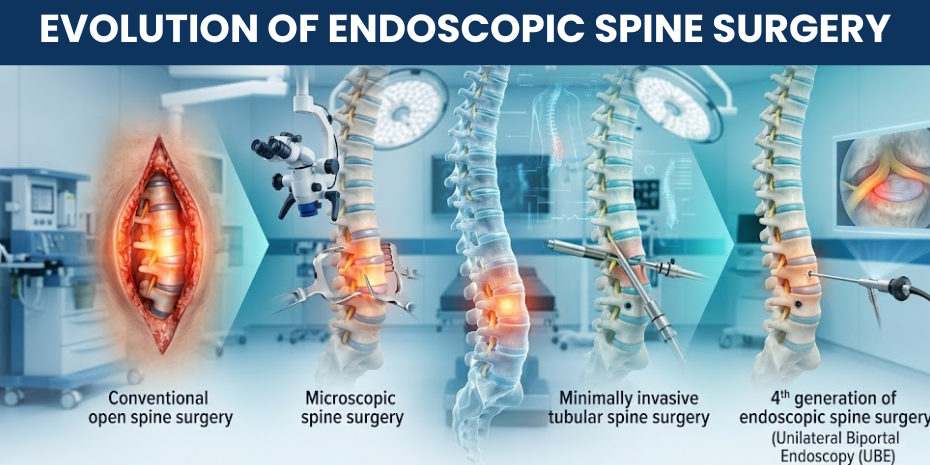
Evolution of Endoscopic Spine Surgery
Spine surgery has undergone a remarkable transformation over the past several decades. What once required large incisions, extensive muscle cutting, prolonged hospitalization, and lengthy recovery has now evolved into highly precise, minimally invasive, and advanced endoscopic procedures.
From Open Surgery to 4th Generation Endoscopic Spine Surgery
Spine surgery has undergone a remarkable transformation over the past several decades.
What once required large incisions, extensive muscle cutting, prolonged hospitalization, and lengthy recovery has now evolved into highly precise, minimally invasive, and advanced endoscopic procedures.
Today, modern spine surgery focuses on:
Maximum precision
Minimal tissue damage
Faster recovery
Better patient comfort
Early return to normal life
The evolution of spine surgery has progressed through multiple stages — from conventional open surgery to the latest UBE / Biportal Endoscopic Spine Surgery, often referred to as 4th Generation Endoscopic Spine Surgery.
Understanding this evolution helps patients appreciate how modern techniques aim to deliver safer and more effective outcomes with less surgical trauma.
Open Spine Surgery
The Traditional Foundation of Spine Surgery
Open spine surgery was the standard approach for many decades.
In this method, surgeons made a relatively large incision to directly access the spine. Muscles and soft tissues were separated extensively to expose the affected area.
Open surgery remains important and may still be necessary in selected complex conditions such as:
Severe spinal deformities
Major instability
Complex trauma
Certain tumors and infections
Limitations of Traditional Open Surgery
Although effective, traditional open surgery often involved:
Larger incisions
Significant muscle injury
Greater blood loss
Higher postoperative pain
Longer hospitalization
Delayed rehabilitation
These limitations led to the development of less invasive surgical techniques.
Microscopic Spine Surgery
The Beginning of Minimally Invasive Thinking
Microscopic spine surgery introduced the use of an operating microscope for enhanced magnification and illumination.
This allowed surgeons to perform procedures through smaller incisions with improved precision.
Microscopic surgery became widely used for:
Slipped disc surgery
Nerve decompression
Lumbar disc prolapse
Advantages Over Open Surgery
Smaller incision
Better visualization
Reduced muscle damage
Less blood loss
Faster recovery
Microscopic surgery represented a major advancement and became the bridge between traditional open surgery and modern minimally invasive techniques.
Tubular / MIS Spine Surgery
Minimally Invasive Spine Surgery (MIS)
The next major evolution was the development of Tubular Minimally Invasive Spine Surgery (MIS).
Instead of large muscle dissection, tubular retractors created a small pathway to the spine while preserving surrounding tissues.
This approach reduced surgical trauma significantly.
Common Uses of Tubular MIS Surgery
Disc prolapse
Lumbar canal stenosis
Selected fusion procedures
Benefits
Smaller scars
Reduced muscle injury
Less pain
Faster mobilization
Shorter hospital stay
Tubular surgery improved patient recovery and paved the way for more advanced endoscopic techniques.
Destandau Endoscopic Surgery
Early Endoscopic Spine Surgery Innovation
The Destandau technique was one of the early forms of endoscopic spine surgery.
It combined endoscopic visualization with specialized instruments to perform lumbar disc surgery through smaller incisions.
This technique gained popularity for treating selected slipped disc cases.
Significance in Spine Surgery Evolution
Destandau surgery demonstrated that spine procedures could be performed using endoscopic assistance while minimizing tissue disruption.
It played an important role in the transition toward modern endoscopic spine surgery systems.
Monoportal Endoscopic Spine Surgery
Single Portal Endoscopic Surgery
Monoportal endoscopic spine surgery uses a single portal through which both the camera and surgical instruments are inserted.
This approach allowed highly targeted decompression and disc removal using very small incisions.
Advantages
Extremely small incision
Minimal blood loss
Reduced postoperative pain
Faster recovery
Limitations
Because both the camera and instruments share one portal, surgical movement may be more restricted in certain complex cases.
Nevertheless, monoportal endoscopy became a major milestone in minimally invasive spine care.
Transforaminal Endoscopic Spine Surgery
A Specialized Endoscopic Approach
Transforaminal endoscopic surgery accesses the spine through the natural opening where nerves exit the spinal canal (foramen).
This technique became especially useful for treating:
Lumbar disc herniation
Sciatica
Foraminal stenosis
In selected cases, procedures can even be performed under local anesthesia.
Benefits
Minimal tissue injury
Day-care possibilities in selected patients
Faster recovery
Smaller scars
This approach expanded the possibilities of truly minimally invasive spine surgery.
UBE / Biportal Endoscopic Spine Surgery
The Rise of 4th Generation Spine Surgery
UBE (Unilateral Biportal Endoscopy) represents one of the most advanced developments in modern spine surgery.
Unlike monoportal systems, UBE uses:
One portal for the camera
One portal for surgical instruments
This “biportal” concept provides:
Greater surgical freedom
Better instrument handling
Wider visualization
More effective decompression
UBE combines the advantages of:
Open surgery
Microscopic surgery
MIS tubular surgery
Endoscopic technology
This is why it is often referred to as 4th Generation Endoscopic Spine Surgery.
Why UBE is a Major Advancement
UBE is considered a major leap forward because it solves several limitations associated with older techniques.
Key Advantages of UBE
Enhanced Visualization
The separate camera portal provides a wider and clearer surgical view.
Better Instrument Movement
Independent working portals allow surgeons to operate more naturally and effectively.
Minimal Muscle Damage
Tiny incisions reduce soft tissue trauma significantly.
Faster Recovery
Patients often experience reduced pain and quicker rehabilitation.
Versatility
UBE can be used for:
Slipped disc surgery
Lumbar canal stenosis
Nerve decompression
Selected fusion surgeries (UBE-TLIF)
Familiar Anatomy for Surgeons
The approach resembles conventional surgical anatomy, helping surgeons perform precise decompression safely.
UBE represents the balance between minimally invasive surgery and advanced surgical control.
Which Technique is Suitable for Which Patient?
There is no single spine surgery technique that is ideal for every patient.
The most suitable approach depends on:
Diagnosis
MRI findings
Severity of nerve compression
Spinal stability
Age and activity level
Previous surgeries
Overall health condition
General Overview
Open Spine Surgery
Suitable for:
Major deformities
Complex instability
Trauma
Tumors
Microscopic Surgery
Suitable for:
Selected slipped disc cases
Limited decompression procedures
Tubular / MIS Surgery
Suitable for:
Minimally invasive decompression
Selected fusion surgeries
Monoportal Endoscopy
Suitable for:
Selected disc prolapse
Targeted decompression
Transforaminal Endoscopy
Suitable for:
Foraminal disc herniation
Sciatica
UBE / Biportal Endoscopy
Suitable for:
Slipped disc
Lumbar canal stenosis
Bilateral decompression
Complex decompression
Selected fusion procedures
The final treatment decision should always be individualized after detailed clinical examination and imaging evaluation.
The Future of Spine Surgery
Modern spine surgery continues to evolve toward:
Smaller incisions
Better visualization
Precision-based treatment
Faster rehabilitation
Motion preservation
Improved patient comfort
UBE / Biportal Endoscopic Spine Surgery is currently considered one of the most advanced forms of minimally invasive spine surgery and represents the future direction of spinal care.
Book an Expert Spine Consultation
If you are suffering from persistent back pain, slipped disc, sciatica, or lumbar canal stenosis, expert evaluation can help determine the most suitable treatment approach for your condition.
Schedule Your Consultation Today
Advanced Spine Evaluation
MRI Review
Minimally Invasive Treatment Planning
Endoscopic Spine Surgery Consultation
Second Opinion for Spine Surgery