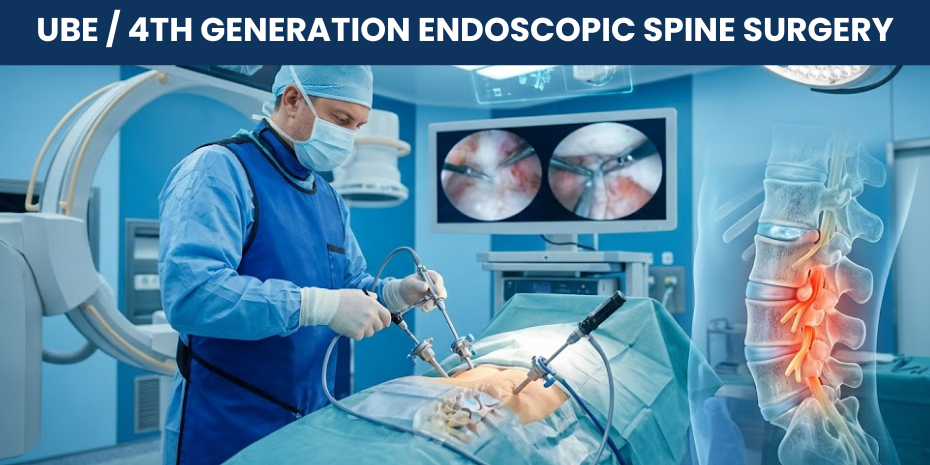
UBE / 4th Generation Endoscopic Spine Surgery
Modern spine surgery has evolved rapidly over the last decade. One of the most advanced innovations today is UBE Spine Surgery (Unilateral Biportal Endoscopy) — also known as Biportal Endoscopic Spine Surgery or 4th Generation Endoscopic Spine Surgery.
Advanced Minimally Invasive Spine Surgery with UBE (Unilateral Biportal Endoscopy)
Modern spine surgery has evolved rapidly over the last decade. One of the most advanced innovations today is UBE Spine Surgery (Unilateral Biportal Endoscopy) — also known as Biportal Endoscopic Spine Surgery or 4th Generation Endoscopic Spine Surgery.
UBE combines the precision of endoscopic technology with the flexibility of conventional surgery while minimizing tissue damage, pain, blood loss, and recovery time.
This technique is increasingly being used worldwide for the treatment of slipped discs, lumbar canal stenosis, nerve compression, and selected spine fusion procedures.
What is UBE Spine Surgery?
UBE (Unilateral Biportal Endoscopy) is an advanced minimally invasive spine surgery technique performed using two tiny portals (small incisions) instead of one large incision.
One portal is used for the camera (endoscope), while the second portal is used for surgical instruments.
This allows the surgeon to operate with enhanced visualization, better instrument movement, and minimal damage to muscles and surrounding tissues.
UBE surgery is commonly performed for:
Slipped disc (Disc prolapse)
Sciatica
Lumbar canal stenosis
Nerve compression
Degenerative spine disease
Selected spine instability and fusion procedures
Why is it Called Biportal?
The term “Biportal” means two portals.
Unlike conventional endoscopic procedures that use a single working channel, UBE uses:
One portal for the endoscopic camera
One portal for surgical instruments
This dual-portal system gives surgeons greater freedom and precision during surgery while maintaining the benefits of minimally invasive techniques.
How is UBE Different from Conventional Spine Surgery?
Traditional open spine surgery often requires:
Large incisions
Extensive muscle cutting
Greater blood loss
Longer hospital stay
Delayed recovery
UBE Spine Surgery is designed to minimize surgical trauma.
Key Differences
Conventional Spine Surgery
Larger incision
Significant muscle dissection
More postoperative pain
Longer recovery
Higher tissue trauma
UBE Spine Surgery
Tiny incisions
Minimal muscle damage
Less pain and blood loss
Faster recovery
Better cosmetic results
Most patients are able to walk within hours after surgery and resume routine activities much earlier compared to conventional procedures.
How is UBE Different from Monoportal Endoscopy?
In monoportal endoscopy, both the camera and instruments pass through a single portal.
In UBE, the camera and instruments are separated into two independent portals.
Advantages of UBE Over Monoportal Techniques
Better surgical freedom
Wider field of vision
Easier handling of instruments
More effective decompression
Better suited for complex spinal conditions
Familiar surgical anatomy for spine surgeons
UBE also allows the use of conventional spine surgical instruments, making advanced decompression procedures more efficient.
Why is UBE Considered 4th Generation Endoscopic Spine Surgery?
UBE is often referred to as 4th Generation Spine Surgery because it represents the next evolution in minimally invasive spinal procedures.
It combines the advantages of:
Traditional open surgery
Microscopic spine surgery
Minimally invasive tubular surgery
Advanced endoscopic visualization
This evolution offers:
Better precision
Enhanced magnification
Reduced tissue injury
Faster rehabilitation
Improved patient comfort
UBE is considered one of the most advanced forms of modern endoscopic spine surgery available today.
Conditions Where UBE May Be Useful
UBE Spine Surgery may be beneficial for several spinal conditions, including:
Slipped disc / herniated disc
Sciatica
Lumbar canal stenosis
Foraminal stenosis
Nerve compression
Degenerative disc disease
Facet cysts
Recurrent disc prolapse
Selected spinal instability cases
Certain fusion surgeries
Suitability depends on MRI findings, symptoms, neurological condition, and clinical evaluation.
UBE for Slipped Disc
A slipped disc occurs when the disc material compresses nearby nerves, causing:
Back pain
Leg pain (Sciatica)
Tingling
Numbness
Weakness
UBE allows precise removal of the herniated disc fragment through tiny incisions while preserving muscles and spinal stability.
Benefits of UBE for Slipped Disc
Minimal tissue damage
Smaller scar
Faster pain relief
Early mobilization
Short hospital stay
Faster return to work
UBE for Lumbar Canal Stenosis
Lumbar canal stenosis is a condition where narrowing of the spinal canal compresses nerves.
Common symptoms include:
Leg pain while walking
Numbness
Weakness
Difficulty standing for long periods
UBE enables effective decompression of the spinal canal with minimal disruption of surrounding structures.
This can significantly improve walking capacity and quality of life in selected patients.
UBE for Spine Fusion / UBE-TLIF
UBE-TLIF (Transforaminal Lumbar Interbody Fusion) is an advanced minimally invasive fusion technique performed using biportal endoscopy.
It may be considered in cases involving:
Spinal instability
Spondylolisthesis
Severe degeneration
Recurrent disc problems
Mechanical back pain associated with instability
UBE-TLIF aims to achieve spinal stabilization while minimizing muscle injury compared to traditional open fusion surgery.
Advantages of UBE Spine Surgery
Key Benefits
Minimally invasive approach
Tiny incisions
Less muscle damage
Reduced blood loss
Lower postoperative pain
Faster recovery
Early mobilization
Shorter hospital stay
Better visualization for surgeons
Reduced infection risk
Improved cosmetic outcome
Faster return to routine activities
Many patients experience quicker rehabilitation compared to conventional spine surgery techniques.
Limitations of UBE Surgery
Although highly advanced, UBE may not be suitable for every patient.
Possible Limitations
Not ideal for all spinal deformities
Certain severe instability cases may require different procedures
Technically demanding surgery
Requires specialized training and expertise
Some complex revision surgeries may need alternative approaches
A detailed spine evaluation is essential before deciding the best treatment option.
Who is a Suitable Candidate for UBE?
You may be a suitable candidate if you have:
Persistent back or leg pain
Sciatica
Numbness or tingling
Lumbar canal stenosis
Slipped disc
Symptoms not improving with medicines or physiotherapy
MRI-confirmed nerve compression
Candidates are selected after detailed clinical examination and imaging evaluation.
Who May Not Be Suitable?
UBE may not be ideal for patients with:
Severe spinal deformity
Extensive instability
Active spinal infection
Certain tumors
Advanced osteoporosis
Complex multi-level pathology in selected cases
Treatment recommendations vary depending on individual spinal conditions.
Recovery Timeline After UBE Surgery
Recovery varies depending on the condition treated and overall patient health.
General Recovery Timeline
Same Day / Next Day
Walking usually begins within hours
1–2 Weeks
Reduction in surgical discomfort
Light activities resumed
2–6 Weeks
Gradual return to routine work
Improved mobility
6–12 Weeks
Functional recovery continues
Rehabilitation exercises progress
Your surgeon may recommend physiotherapy and activity modifications during recovery.
Frequently Asked Questions
Is UBE Spine Surgery Safe?
UBE is considered a safe and advanced minimally invasive procedure when performed by experienced spine surgeons in appropriately selected patients.
Is UBE Better Than Open Spine Surgery?
UBE offers several minimally invasive advantages including less pain, smaller incisions, and faster recovery. However, the best procedure depends on the patient’s condition.
How Long Does UBE Surgery Take?
Surgery duration depends on the complexity and number of spinal levels involved.
Is Hospital Stay Required?
Most patients require a short hospital stay, often 1–3 days depending on the procedure.
Will There Be a Large Scar?
No. UBE uses very small incisions, resulting in minimal scarring.
When Can I Return to Work?
Many patients can resume light work within a few weeks, depending on recovery and job type.
Book a Consultation for UBE Spine Surgery
If you are suffering from persistent back pain, sciatica, slipped disc, or lumbar canal stenosis, expert evaluation can help determine whether UBE Spine Surgery may be suitable for you.
Schedule Your Appointment Today
Get advanced evaluation and personalized treatment guidance for minimally invasive and endoscopic spine surgery.
Contact Us
Book an Appointment
Request MRI Review
Consult Spine Specialist
Get Second Opinion