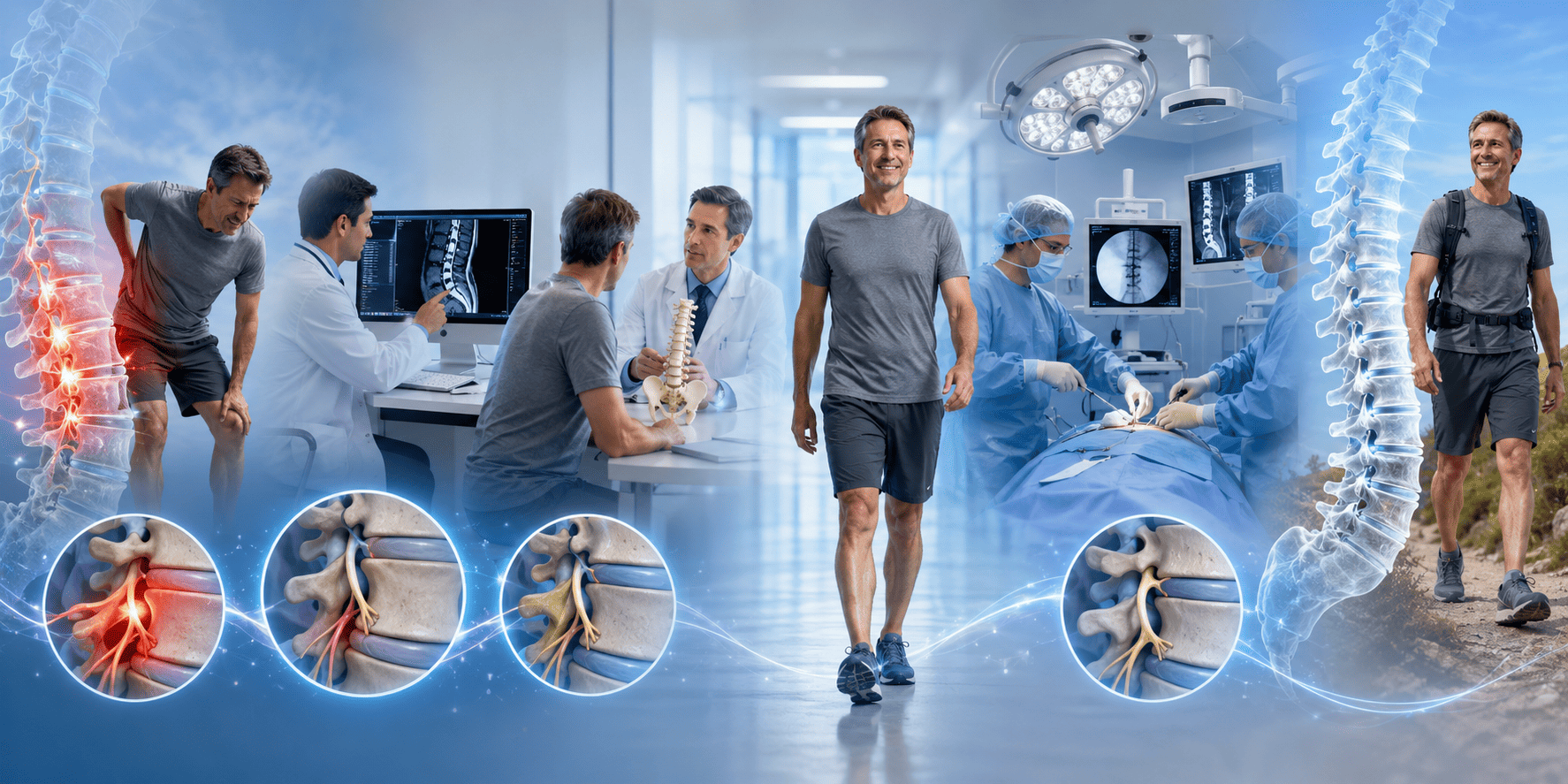
Case Stories / Recovery Stories
Every spine condition is unique, and every patient’s recovery journey is different. These case stories are shared with appropriate patient consent and are intended for educational purposes only. They reflect individualized treatment decisions based on symptoms, MRI findings, lifestyle needs, overall health, and detailed clinical evaluation.
Real Patient Journeys in Modern Spine Care
Every spine condition is unique, and every patient’s recovery journey is different.
These case stories are shared with appropriate patient consent and are intended for educational purposes only. They reflect individualized treatment decisions based on symptoms, MRI findings, lifestyle needs, overall health, and detailed clinical evaluation.
The goal of these stories is not to promote “miracle cures,” but to help patients better understand:
Common spine conditions
Treatment decision-making
Role of minimally invasive spine surgery
Recovery expectations
Importance of timely diagnosis and rehabilitation
Case 1: Elderly Patient with Severe Lumbar Canal Stenosis Treated with UBE Decompression
Problem
A 72-year-old patient presented with progressive walking difficulty and severe leg pain affecting daily activities.
Symptoms
Pain in both legs while walking
Numbness and heaviness in legs
Need to stop walking after short distances
Difficulty standing for long periods
The patient had already tried medications and physiotherapy with limited relief.
MRI Finding
MRI showed severe lumbar canal stenosis causing compression of the spinal nerves.
Treatment Decision
Considering the patient’s age, symptoms, and MRI findings, minimally invasive decompression using UBE (Unilateral Biportal Endoscopic) Spine Surgery was discussed as a treatment option.
The goal was nerve decompression while minimizing tissue disruption.
Procedure
UBE decompression surgery was performed using two small portals with endoscopic visualization.
Compressed nerves were carefully decompressed while preserving surrounding structures as much as possible.
Recovery
Walking started early after surgery
Gradual improvement in leg symptoms
Improved walking tolerance over the following weeks
Rehabilitation and strengthening exercises were continued
Learning Point
Lumbar canal stenosis in elderly patients can significantly affect mobility and quality of life. Carefully selected minimally invasive decompression procedures may help improve walking capacity and reduce nerve compression symptoms.
Case 2: Young Professional with Slipped Disc Treated by UBE Discectomy
Problem
A 34-year-old working professional developed severe sciatica affecting work and routine activities.
Symptoms
Sharp leg pain radiating below the knee
Tingling and numbness
Difficulty sitting for long periods
Sleep disturbance due to pain
Conservative treatment including medicines and physiotherapy had not provided adequate relief.
MRI Finding
MRI revealed lumbar disc herniation compressing the nerve root.
Treatment Decision
After detailed evaluation, UBE discectomy was considered because symptoms were persistent and affecting quality of life.
Procedure
A minimally invasive UBE discectomy was performed to remove the disc fragment compressing the nerve.
Recovery
Early mobilization after surgery
Significant reduction in leg pain
Gradual return to office work
Continued posture correction and core strengthening advised
Learning Point
Most slipped disc cases improve without surgery. However, persistent sciatica with nerve compression may require surgical treatment in selected patients.
Case 3: Recurrent Slipped Disc Managed with Revision Endoscopic Surgery
Problem
A patient developed recurrent leg pain after previous lumbar disc surgery performed elsewhere.
Symptoms
Return of sciatica symptoms
Numbness in the leg
Difficulty walking comfortably
MRI Finding
MRI demonstrated recurrent disc herniation at the previously operated spinal level.
Treatment Decision
After evaluating MRI findings, prior surgical history, and patient symptoms, revision endoscopic surgery was considered.
Procedure
Revision endoscopic decompression and disc removal were performed using minimally invasive techniques.
Recovery
Gradual reduction in recurrent leg pain
Early rehabilitation initiated
Functional recovery improved over time
Learning Point
Persistent or recurrent symptoms after spine surgery require careful evaluation. Not every patient with recurrent pain needs major open revision surgery.
Case 4: Spondylolisthesis Treated with UBE-TLIF
Problem
A middle-aged patient presented with chronic back pain and nerve compression symptoms due to spinal instability.
Symptoms
Mechanical back pain
Sciatica
Walking discomfort
Reduced activity tolerance
MRI Finding
MRI and dynamic X-rays showed lumbar spondylolisthesis with nerve compression and instability.
Treatment Decision
Because spinal instability was present, decompression alone was not considered sufficient. UBE-TLIF (Biportal Endoscopic Fusion Surgery) was planned.
Procedure
UBE-TLIF was performed using minimally invasive biportal endoscopic techniques for decompression and stabilization.
Recovery
Early postoperative mobilization
Gradual improvement in back and leg symptoms
Structured rehabilitation and strengthening exercises continued
Learning Point
Spinal instability may require fusion procedures in selected patients. Treatment decisions should always be based on both symptoms and spinal stability assessment.
Case 5: Failed Previous Spine Surgery Evaluated & Managed
Problem
A patient continued to experience persistent pain after previous spine surgery.
Symptoms
Ongoing back pain
Intermittent leg symptoms
Difficulty with prolonged standing
MRI Finding
Detailed imaging showed residual stenosis and degenerative spinal changes.
Treatment Decision
The patient underwent careful evaluation to identify whether symptoms were surgically correctable. Non-surgical treatment options were also discussed.
Procedure
A personalized treatment strategy including targeted decompression and rehabilitation planning was performed.
Recovery
Gradual functional improvement
Continued physiotherapy and conditioning
Long-term spine care emphasized
Learning Point
Persistent pain after spine surgery does not always mean “failed surgery.” Careful diagnosis and individualized treatment planning are essential before considering revision procedures.
Important Note About Recovery Stories
Every patient is different.
Recovery outcomes depend on:
Severity of spinal disease
Duration of nerve compression
Age and health condition
Rehabilitation participation
Surgical complexity
Lifestyle and posture habits
These stories are educational examples and should not be interpreted as guaranteed outcomes.
Ethical & Evidence-Based Spine Care
Our approach focuses on:
Accurate diagnosis
Conservative treatment whenever appropriate
Personalized surgical planning
Minimally invasive solutions when suitable
Realistic patient counseling
Long-term spine health and rehabilitation
The goal is always to provide safe, evidence-based, and patient-centered spine care.