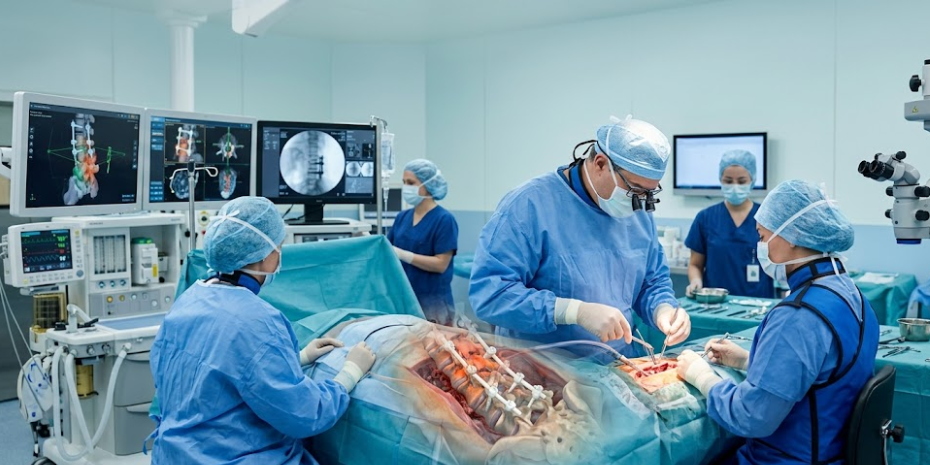
Advanced Evaluation & Treatment for Persistent or Recurrent Spine Problems
Revision Spine Surgery refers to a second or repeat spinal procedure performed after a previous spine surgery when symptoms persist, recur, or new spinal problems develop.
Patients may continue to experience:
Back pain
Sciatica
Numbness
Weakness
Walking difficulty
Recurrent nerve compression
after earlier spinal surgery.
Revision surgery is often more complex than first-time spine surgery and requires detailed evaluation, precise diagnosis, and individualized treatment planning.
Modern minimally invasive and endoscopic techniques, including UBE (Unilateral Biportal Endoscopic) Spine Surgery, may offer advanced treatment options in selected revision cases.
What is Revision Spine Surgery?
Revision spine surgery is performed to address ongoing or recurrent spinal symptoms after a previous operation.
The goal is to:
Identify the exact cause of persistent symptoms
Relieve nerve compression
Improve spinal stability when required
Reduce pain
Restore function and mobility
Revision surgery may involve:
Repeat decompression
Revision discectomy
Scar tissue management
Implant revision
Spinal fusion procedures
Endoscopic decompression techniques
Each revision case is unique and requires careful planning.
Who May Need Revision Spine Surgery?
Revision surgery may be considered in patients with persistent or recurrent symptoms after previous spinal procedures.
Common Conditions Requiring Revision Evaluation
Recurrent Slipped Disc
A new disc herniation occurring at the same level after prior surgery.
Residual Nerve Compression
Persistent compression not fully relieved during earlier surgery.
Scar Tissue Formation
Fibrosis around spinal nerves causing irritation or pain.
Lumbar Canal Stenosis
Progressive spinal narrowing after earlier procedures.
Adjacent Segment Degeneration
Degeneration developing near previously operated spinal levels.
Implant or Fusion Problems
Hardware issues or incomplete spinal fusion.
Spinal Instability
Abnormal spinal movement leading to ongoing symptoms.
Symptoms That May Suggest Need for Revision Evaluation
Persistent back pain after surgery
Recurrent sciatica
Leg numbness or weakness
Difficulty walking
Pain returning months or years after surgery
New neurological symptoms
Reduced quality of life despite prior treatment
Importantly, not every patient with pain after surgery requires another operation.
Accurate diagnosis is essential before considering revision surgery.
How is Revision Spine Surgery Performed?
The exact procedure depends on the underlying cause identified during evaluation.
Step-by-Step Overview
Detailed Evaluation
Clinical examination, MRI, CT scan, and dynamic X-rays may be required.
Identification of Pain Source
The surgeon determines whether symptoms are due to recurrent disc prolapse, scar tissue, instability, stenosis, or implant-related issues.
Surgical Planning
A personalized surgical strategy is created based on anatomy, prior surgery, and patient goals.
Minimally Invasive or Endoscopic Access
In selected cases, modern endoscopic or minimally invasive approaches may be used to minimize additional tissue trauma.
Decompression or Stabilization
Compressed nerves are relieved, and spinal stabilization may be performed if necessary.
Role of Endoscopic & UBE Surgery in Revision Cases
Modern endoscopic spine surgery has become increasingly valuable in selected revision spine surgery patients.
Advanced Techniques May Include
Endoscopic Revision Discectomy
Removal of recurrent disc fragments through minimally invasive portals.
UBE (Biportal Endoscopic) Revision Surgery
Uses:
One portal for the camera
One portal for surgical instruments
to provide enhanced visualization and surgical flexibility.
Endoscopic Decompression
Targeted nerve decompression with minimal tissue disruption.
UBE is particularly useful in selected revision cases because the biportal system allows improved visualization in previously operated areas.
Benefits of Revision Spine Surgery
Potential Advantages
Relief of Persistent Nerve Compression
Reduction of leg pain, numbness, and weakness.
Improved Walking & Function
Many patients experience better mobility after proper decompression.
Modern Minimally Invasive Options
Selected patients may benefit from smaller incisions and reduced tissue damage.
Better Diagnostic Accuracy
Advanced imaging and surgical planning improve treatment precision.
Reduced Tissue Trauma in Endoscopic Procedures
Endoscopic approaches may help minimize additional muscle injury.
Personalized Treatment Approach
Each revision surgery is customized to the patient’s specific condition.
Risks & Limitations of Revision Spine Surgery
Revision procedures are generally more technically demanding than first-time spine surgery.
Possible Risks Include
Infection
Bleeding
Persistent pain
Scar tissue-related difficulty
Nerve irritation or injury
Dural tear (CSF leak)
Recurrent symptoms
Implant complications
Incomplete symptom relief
Limitations of Revision Surgery
Not all persistent pain after surgery has a surgically correctable cause.
Some patients may benefit more from:
Physiotherapy
Rehabilitation
Pain management
Lifestyle modification
Non-surgical spine care
An ethical, evidence-based approach is important to avoid unnecessary repeat surgery.
Recovery Timeline After Revision Spine Surgery
Recovery depends on:
Complexity of revision surgery
Severity of nerve compression
Previous surgeries
Patient health and rehabilitation
General Recovery Timeline
Same Day / Next Day
Walking often begins early in minimally invasive procedures
1–2 Weeks
Gradual reduction in surgical discomfort
Light activity resumed
2–6 Weeks
Improved mobility and function
Rehabilitation progresses
6–12 Weeks
Continued strengthening and recovery
Long-Term Recovery
Functional rehabilitation
Posture correction
Core strengthening
Lifestyle modification
Recovery may take longer in complex revision cases compared to first-time surgery.
Who May Not Be Suitable for Revision Surgery?
Alternative treatment strategies may be recommended for patients with:
No surgically correctable pathology
Severe medical comorbidities
Diffuse pain without nerve compression
Advanced osteoporosis in selected cases
High surgical risk conditions
Careful evaluation is critical before proceeding with repeat spinal surgery.
Frequently Asked Questions
Does Persistent Pain After Surgery Mean the First Surgery Failed?
Not necessarily. Persistent symptoms may occur for several reasons, many of which may still be treatable.
Is Another Surgery Always Required?
No. Many patients improve with non-surgical treatment and rehabilitation.
Is Revision Surgery More Complex?
Yes. Revision procedures are generally more technically demanding due to scar tissue and altered anatomy.
Can Endoscopic Surgery Be Used in Revision Cases?
Yes. Selected patients may benefit from advanced endoscopic or UBE revision procedures.
Will Recovery Take Longer?
Recovery varies depending on the complexity of surgery and overall patient condition.
Is Revision Spine Surgery Safe?
When properly planned and performed in appropriately selected patients, revision spine surgery can be a safe and effective treatment option.
Ethical & Evidence-Based Revision Spine Care
Every patient with persistent pain after spine surgery deserves a careful and honest evaluation.
Our approach focuses on:
Accurate diagnosis
Avoiding unnecessary repeat surgery
Conservative treatment whenever appropriate
Advanced minimally invasive solutions when beneficial
Personalized treatment planning
The goal is always to provide the safest and most appropriate treatment for long-term functional improvement.
Book a Consultation for Revision Spine Surgery
If you continue to experience back pain, sciatica, numbness, or walking difficulty after previous spine surgery, expert evaluation can help determine the underlying cause and guide the most suitable treatment plan.
Schedule Your Appointment Today
MRI Review
Revision Spine Surgery Evaluation
Endoscopic Spine Surgery Consultation
Second Opinion for Spine Surgery
Personalized Treatment Planning