Understanding the Difference Between Two Advanced Endoscopic Spine Surgery Techniques
Modern spine surgery has evolved significantly over the past two decades, with minimally invasive and endoscopic procedures becoming increasingly popular for treating slipped disc, sciatica, spinal stenosis, and nerve compression disorders.
Among the advanced techniques used today are:
· UBE (Unilateral Biportal Endoscopic Surgery)
· Transforaminal Endoscopic Spine Surgery
Both techniques aim to reduce tissue damage, improve recovery, and minimize surgical trauma compared to traditional open surgery.
However, these procedures are not identical.
Each technique has its own strengths, indications, advantages, and limitations.
Most importantly:
“No single technique is best for every patient.”
The correct surgical approach depends on:
· Type of spinal pathology
· Patient anatomy
· Degree of nerve compression
· Presence of instability
· Surgeon experience
· Previous surgeries
· Overall patient factors
The goal should always be selecting the safest and most appropriate treatment for each individual patient.
What is UBE (Unilateral Biportal Endoscopic Surgery)?
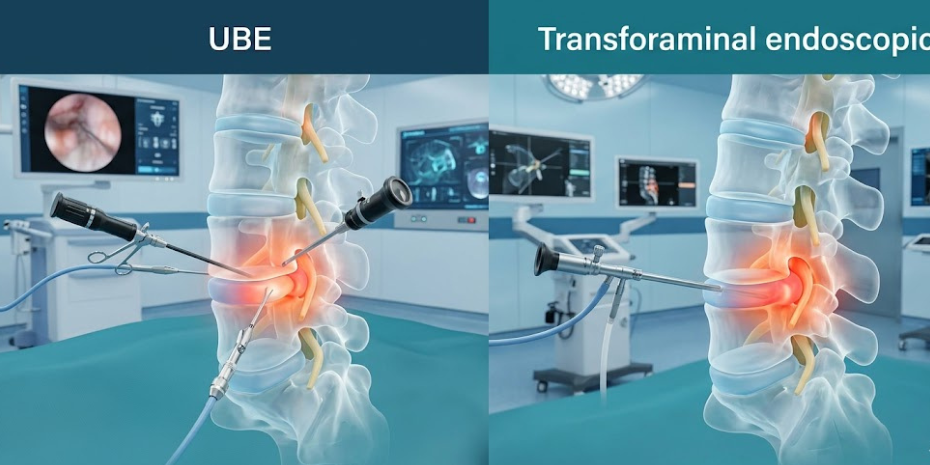
UBE is an advanced minimally invasive spine surgery technique that uses:
· One portal for the endoscopic camera
· One portal for surgical instruments
This “biportal” system allows the surgeon to work with greater flexibility while maintaining continuous high-definition visualization.
UBE is increasingly recognized as part of the evolution toward 4th Generation Endoscopic Spine Surgery.
Common Conditions Treated with UBE
· Slipped disc
· Sciatica
· Lumbar canal stenosis
· Foraminal stenosis
· Selected revision surgeries
· UBE-TLIF fusion procedures
What is Transforaminal Endoscopic Spine Surgery?
Transforaminal Endoscopic Spine Surgery is a minimally invasive technique where the spine is accessed through the natural opening called the “foramen” from the side of the spine.
This procedure is commonly performed using a single working portal that contains both:
· The camera
· Surgical instruments
The transforaminal approach allows targeted access to selected disc herniations and nerve compression conditions.
Common Conditions Treated with Transforaminal Endoscopy
· Lumbar slipped disc
· Sciatica
· Foraminal disc herniation
· Selected recurrent disc cases
· Certain stenosis conditions
Key Difference Between UBE & Transforaminal Endoscopy
UBE (Biportal)
· Two separate portals
· Independent camera and instrument movement
· Wider surgical working space
· Greater flexibility for decompression
Transforaminal Endoscopy
· Usually single portal
· Camera and instruments pass through the same working channel
· Access through the natural foraminal pathway
· Highly targeted minimally invasive approach
Both are advanced endoscopic procedures, but their surgical mechanics and working angles differ.
Surgical Visualization & Working Space
UBE
UBE provides:
· Wide magnified visualization
· Flexible instrument movement
· Familiar anatomical orientation
· Ability to perform broader decompression
This can be particularly useful in:
· Lumbar canal stenosis
· Bilateral decompression
· Complex decompression cases
· Selected revision surgeries
Transforaminal Endoscopy
Transforaminal surgery provides:
· Direct targeted access
· Minimal tissue disruption
· Excellent approach for selected disc herniations
It is especially useful in carefully selected cases involving:
· Foraminal disc prolapse
· Lateral disc pathology
· Selected sciatica patients
UBE vs Transforaminal Endoscopy for Slipped Disc
Both techniques may be used successfully for slipped disc treatment in selected patients.
UBE May Be Preferred in Some Cases When:
· There is central canal stenosis
· Wider decompression is required
· Bilateral nerve decompression is needed
· Anatomy is more complex
Transforaminal Endoscopy May Be Suitable When:
· Disc herniation is localized
· Foraminal access is favorable
· Targeted decompression is sufficient
The final decision depends on MRI findings and surgical planning.
UBE vs Transforaminal Endoscopy for Lumbar Canal Stenosis
Lumbar canal stenosis often requires wider decompression of compressed nerves.
UBE Advantages in Stenosis Cases
The biportal system may allow:
· Wider decompression
· Better visualization
· More flexibility around neural structures
· Bilateral decompression through limited access
This is one reason UBE has gained popularity for stenosis surgery.
However, treatment decisions remain individualized.
Fusion Surgery Capability
UBE
UBE technology has expanded into minimally invasive fusion procedures such as:
· UBE-TLIF
· Endoscopic decompression with stabilization
Transforaminal Endoscopy
Traditional transforaminal endoscopy is more commonly associated with decompression and disc procedures rather than broader fusion applications.
Recovery Comparison
Both procedures are minimally invasive and may offer:
· Smaller incisions
· Reduced muscle injury
· Faster mobilization
· Less postoperative pain
· Shorter hospital stay
Recovery depends more on:
· Disease severity
· Type of procedure
· Nerve compression duration
· Patient health
· Rehabilitation
rather than simply the technique name alone.
Is One Technique Better Than the Other?
The Most Important Principle
There is no universally “best” technique for every patient.
Each surgical method has:
· Specific indications
· Advantages
· Technical considerations
· Limitations
The best procedure depends on:
· Patient symptoms
· MRI findings
· Spinal stability
· Anatomy
· Surgical goals
· Surgeon expertise
A technique that works exceptionally well for one patient may not be ideal for another.
Importance of Proper Patient Selection
Successful spine surgery depends heavily on:
· Accurate diagnosis
· Proper patient selection
· Correct surgical planning
· Evidence-based decision-making
The focus should always remain on:
“Choosing the right surgery for the right patient.”
rather than promoting one technique as universally superior.
Advantages of UBE
Potential Advantages
· Wider working space
· Independent camera and instrument movement
· Excellent visualization
· Effective decompression capability
· Useful for stenosis and bilateral decompression
· Ability to perform selected fusion procedures
Advantages of Transforaminal Endoscopy
Potential Advantages
· Highly targeted approach
· Minimal tissue disruption
· Excellent for selected foraminal disc herniations
· Small skin incision
· Effective in properly selected cases
Limitations of Both Techniques
Neither procedure is suitable for every spinal condition.
Certain patients may still require:
· Microscopic surgery
· Tubular minimally invasive surgery
· Fusion surgery
· Conventional open procedures
Complex spinal deformity, instability, severe trauma, or advanced multi-level disease may require different approaches.
Frequently Asked Questions
Is UBE the Same as Transforaminal Endoscopy?
No. Both are endoscopic spine surgery techniques, but they differ in surgical approach, portal design, and working mechanics.
Which Technique is Better for Slipped Disc?
Both may be effective depending on the type and location of disc herniation.
Is UBE Better for Spinal Stenosis?
UBE may offer advantages in selected stenosis cases requiring broader decompression.
Can Both Procedures Be Minimally Invasive?
Yes. Both techniques are minimally invasive spine surgery approaches.
Does Every Patient Need Endoscopic Surgery?
No. Many patients improve with conservative treatment and never require surgery.
Is Recovery Faster Than Open Surgery?
Many patients experience faster recovery and reduced tissue trauma compared to traditional open surgery.
Ethical & Evidence-Based Spine Care
Modern spine surgery should never focus on promoting one technique for every patient.
Instead, the priority should always be:
· Accurate diagnosis
· Conservative treatment whenever appropriate
· Personalized surgical planning
· Evidence-based decision-making
· Selecting the safest and most suitable procedure
The ultimate goal is achieving the best functional outcome for the patient.
Book a Consultation for Endoscopic Spine Surgery
If you are suffering from slipped disc, sciatica, spinal stenosis, or persistent nerve compression symptoms, expert spine evaluation can help determine which treatment approach may be most appropriate for your condition.
Schedule Your Appointment Today
· MRI Review
· Endoscopic Spine Surgery Consultation
· UBE Spine Surgery Evaluation
· Second Opinion for Spine Surgery
· Personalized Treatment Planning